
There are fewer things that bring more smiles to the vet clinic than an owner bringing in their new wiggly happy puppy. It’s an exciting time for families to be adding a furry member, but it can also be overwhelming too! We wish I had an hour to sit down with every family that comes in to go over some truly important puppy topics, but unfortunately that reality is not often possible. Because of this having resources for owners to read/keep has become a must. We’ve included top tips and considerations for socialization/behavior here for new puppy owners!
- Having a well adjusted puppy takes time and training.
- Puppies are sweet and curious creatures, but it’s important to remember that dogs don’t magically grow up to be well behaved and easy going. There are many new experiences that puppies will go through that shape the type of dog they eventually become. While it is easy to assume all puppies are mellow and welcoming, some puppies are timid and fearful. Did you know that behavioral problems are one of the number one reasons why dogs are relinquished to shelters or requested to be put to sleep? If you have a puppy at home, you have a wonderful opportunity to help them jump through the hoops towards becoming a well adjusted dog.
- Puppies experience their primary “learning” and “socialisation” period up to about 12-16 weeks of age.
- This means that the optimal window for teaching them how to acclimatize to new situations is before they hit this age. This often surprises owners, but I like to turn this into a plus. This gives us the chance to help puppies become great doggos.
- Vaccinations vs. Socialization: When is it safe to take my puppy out?
The answer is, it depends. This question arises because we know the primary socialisation period is prior to 12-16 weeks of age, but puppies have not completed their initial vaccine series to receive disease protection until that age or later. Our answer is to pick safe socialization opportunities, as we should ideally not wait to introduce new experiences.
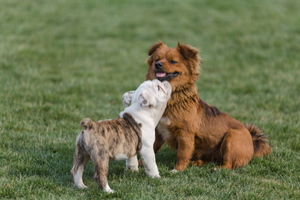
What are safe experiences? Just because your puppy is still receiving starting boosters, doesn’t mean you can’t carry them places with you. Carrying them on a short walk or taking them in the car for small trips is a great place to start. They feel safe because they are close to you but can see and smell new things. Another option is playing with dogs of different ages/sizes in a garden that is isolated ie. your back garden. Allowing your puppy to have supervised time with other dogs that are vaccinated, on parasite prevention, and are good with other dogs is a great chance for socialisation. Make sure to watch your puppy’s response to other dogs and stop the interaction if they are becoming overwhelmed/scared. We want to foster positive associations with new friends.
- Short and sweet is key.
- Keeping new experiences short and positive allows for puppies to avoid becoming overwhelmed and stressed. 10-15 minutes can often be enough at one time, though repetition over time is also important. Positive reinforcement for positive behaviors/responses are much easier for puppies to remember and associate with future behaviors. For example, a positive experience with treats and praise is much more likely to lead to repeat behaviors in the future.
- Remember that puppies will often be nervous in new situations.
- We need to keep in mind that pretty much everything is new to puppies that are weeks to months old, and these things may be scary. Trying to avoid triggers can be helpful to creating a positive experience. For example, being on the floor with your puppy and a new person instead of having them lean over or get into the puppy’s face is a less confrontational way to introduce them. Don’t forget treats! Sounds can also be scary, so exposure to things like cars, vacuums, lawn mowers, washing machines, hair dryers, etc. are useful.
- Vary the exposure.
- The more types of dogs and people your puppy gets exposed to, the easier it will be for them to associate a positive experience with new situations. This particularly comes into play with children. Children are often unpredictable in terms of sounds, smells, and behaviors which can be challenging for puppies to comprehend. Getting puppies used to children is a good way to curb a common dog fear later on in life. It is also essential to teach your children appropriate behavior around dogs! Puppies and children should never be left unsupervised.
- Puppy socialization classes can be a real plus.
- Classes at reputable locations such as vet clinics are a great opportunity for puppies to learn what behaviors towards other dogs are welcome vs. discouraged. Be sure to check what vaccinations and faecal tests are required prior to classes, as safe classes should require vaccinations and a negative faecal to prevent the spread of disease.
- Don’t forget to make the vet less scary too!
- Taking your pet to the vet can be stressful for everyone involved, but it doesn’t have to be. This one is tough given our current COVID pandemic, however, trips to the vet’s office to do a quick “say hi and get a treat” without having any treatments done can be extremely helpful to teach puppies that the vet doesn’t have to be a scary place.
- Consider training tools to help make a ROUTINE.
- I often encourage owners to “crate train” their puppy. This doesn’t necessarily have to be a crate/kennel, it can even be a small pen if it’s strong enough to keep them contained. There are a few reasons I am such a fan of crate training:
- It provides a safe place for your puppy to be unsupervised.
- It helps create a routine, especially when it comes to potty training.
- It creates a trained separation for safe sleeping habits (that being said all of my dogs end up sleeping on our bed later on, who am I kidding).
- Puppies are all about routine. The best training protocols rely on creating one that works for you and your puppy then sticking to it. Consistency helps reinforce concepts you are trying to teach, and also helps them retain these faster. This takes some of the uncertainty out of learning for puppies and can relieve stress in new situations.
- I often encourage owners to “crate train” their puppy. This doesn’t necessarily have to be a crate/kennel, it can even be a small pen if it’s strong enough to keep them contained. There are a few reasons I am such a fan of crate training:
KEY POINTS:
Positive rewards for positive behavior/interactions, routine, and consistency win the game here. Exposing your pet to a variety of safe new environments, people, and animals while they are growing is essential to helping them grow into a well adjusted adult dog.
Dr. Kirsten